
Quiet water pumps are ideal for homes where minimizing operating noise is important, especially homes with pumps installed near bedrooms, living rooms, relaxation areas, or properties located close to neighboring houses. Such as townhouses and homes with limited space for pump installation.
However, the noise level of a water pump system depends on more than just the pump itself. Noise can also come from the motor, vibrations, water flow, piping system, and installation location. Therefore, before choosing a quiet water pump, it is important to consider the operating noise level, pump performance, and actual installation conditions to ensure the pump is suitable for your home.
Some of the noise produced by a water pump comes from the operation of the motor, impeller, and internal components. The noise level varies depending on the pump type, motor speed, construction, and design of each model.
Vibrations from a water pump can be transmitted through floors, walls, and building structures. If the mounting base is unstable or the pump is in direct contact with the building structure, vibrations may amplify the noise, making it more noticeable even when the pump itself operates relatively quietly.
Noise can be caused by water flowing through pipes, changes in flow direction, pipe size, elbows, valves, and pressure conditions within the system. Therefore, noise heard near a water pump may not come from the motor alone.
Quiet water pumps are suitable for homes where minimizing operating noise is important, especially when the pump is installed near living areas, bedrooms, or neighboring properties. However, pump performance and installation conditions should also be considered to ensure the system operates efficiently and quietly.
Examples of homes and pump installation locations where special attention should be paid to water pump noise levels.
1. Pump Installed Near Bedrooms or Relaxation Areas
If a water pump is installed near bedrooms, living rooms, or other areas where a quiet environment is important, motor noise and vibrations may disturb occupants and affect their comfort and relaxation.
2. Homes with Limited Space for Pump Installation
Townhouses, semi-detached houses, and homes with water pumps installed close to the building often have limited distance between the pump and living areas. Therefore, operating noise and vibrations should be carefully considered when selecting a water pump.
3. Homes Located Close to Neighboring Properties
If a water pump is installed near a fence or shared wall, operating noise may travel to neighboring properties, particularly at night.
4. Homes with Frequent Water Usage at Night
Homes where occupants frequently use water late at night or early in the morning, such as for showering, doing laundry, or other daily activities, should consider a quiet water pump with an operating noise level suitable for its installation location.
In Short
Homes with water pumps installed near bedrooms, living areas, or neighboring properties should pay particular attention to pump noise levels. However, installation conditions, mounting bases, and piping systems can also affect the overall noise level.
A pump’s dB rating helps indicate its operating noise level, but it should not be the only factor when choosing a quiet water pump. The actual noise level experienced by users also depends on the installation location, distance from the pump, vibrations, piping system, and noise measurement conditions.
The decibel (dB) rating indicates the noise level of a water pump and provides a reference for comparing the operating noise of different pump models. For an accurate comparison, noise levels should be measured under similar testing conditions.
Used for: Basic Comparison of Water Pump Noise Levels
The actual noise level experienced by users can vary depending on the distance from the pump, vibrations transmitted through floors and walls, installation location, pipe size, water flow, and system pressure. Therefore, even a water pump with a low dB rating may still cause noticeable noise if it is not properly installed.
Other Factors to Consider: Installation location, mounting base, piping system, and actual site conditions.
The installation location has a significant impact on water pump noise levels, as noise and vibrations can travel through floors, walls, and piping systems. Even a water pump with a low operating noise level may become more noticeable if it is installed in an unsuitable location.
The mounting surface should be strong, stable, and level to help reduce vibrations and prevent the pump from moving during operation.
Maintain sufficient distance between the pump, walls, and living areas wherever installation conditions allow to help reduce noise transmission into the building.
Proper pipe alignment and secure pipe supports can help reduce vibration transmission through the piping system.
Avoid installing the pump in confined or poorly ventilated spaces. Ensure adequate clearance for inspection, servicing, and routine maintenance.
The WALRUS WQ_B Series is a range of automatic water pressure booster pumps featuring a fanless, water-cooled motor design that helps reduce operating noise. The series includes the WQ200B, WQ400B, and WQ800B models, allowing homeowners to choose a pump based on their specific water supply requirements. When selecting a model, it is important to consider the required flow rate (Flow), total head (Head), and pump performance curve (Pump Curve), along with the operating noise level and actual installation location. A water pump should not be selected based on wattage alone.
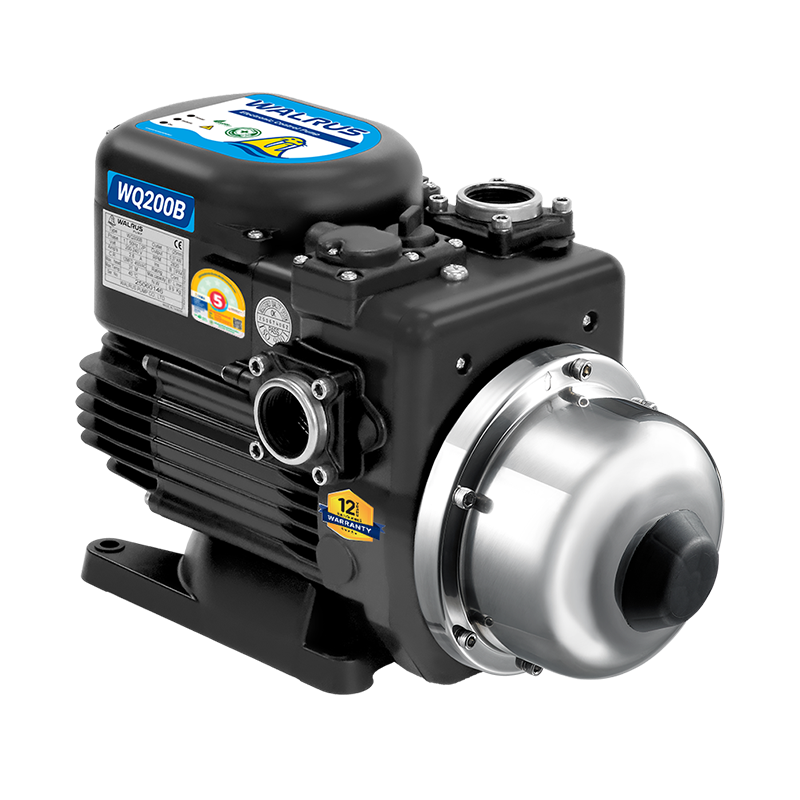
Power: 180 W
A quiet automatic water pump suitable for homes with relatively few water outlets, designed to help minimize operating noise.
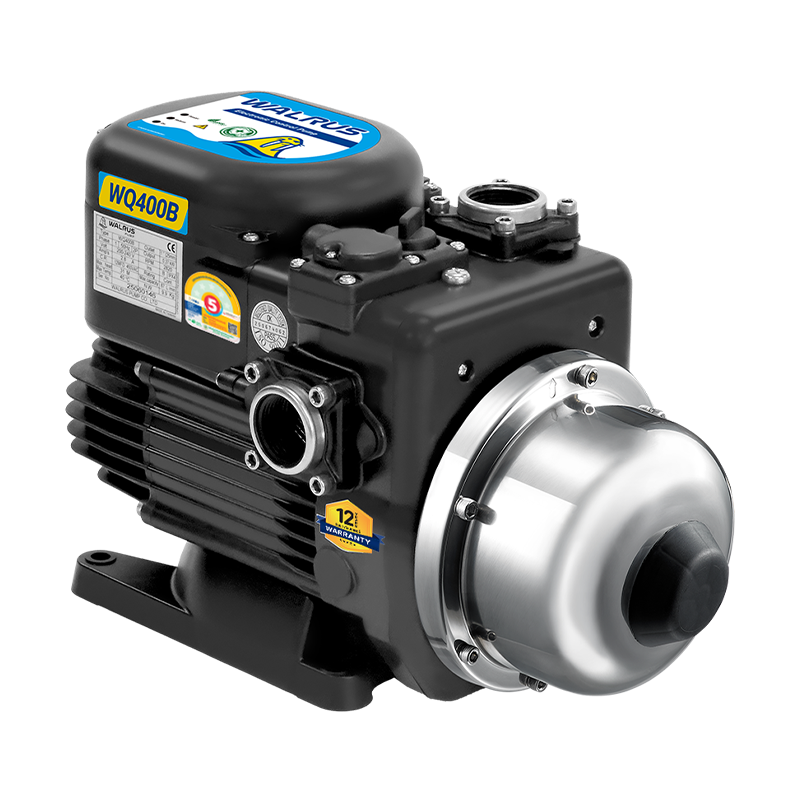
Power: 370 W
Suitable for residential homes with multiple water outlets that require reliable water pressure and quiet operation.
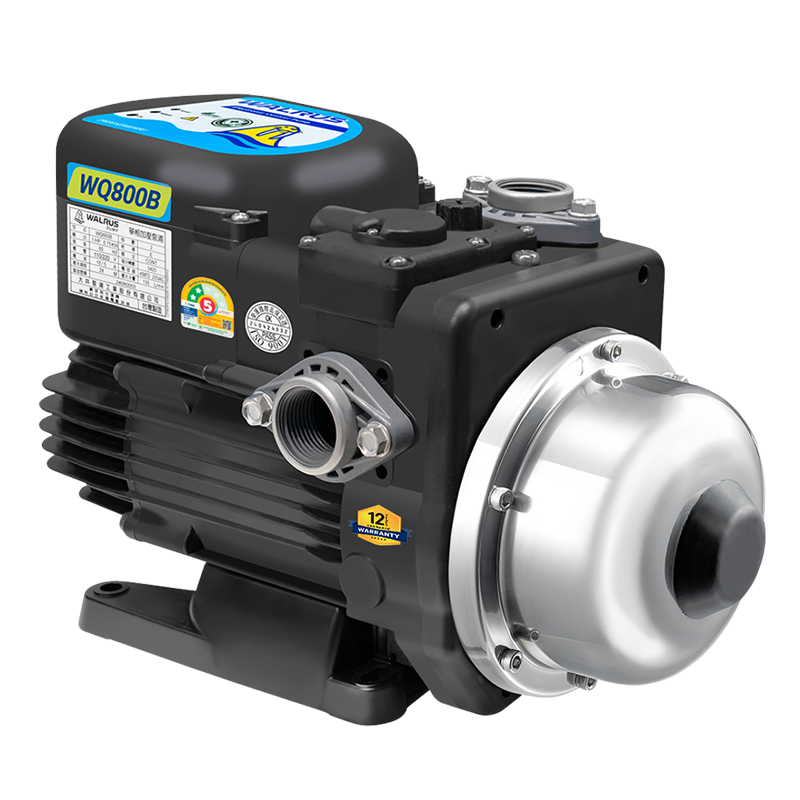
Power: 750 W
Suitable for homes or water supply systems with higher water demand that require an automatic water pump capable of supplying multiple water outlets simultaneously while maintaining quiet operation.
In addition to its quiet operation, the WALRUS WQ Series features an automatic control system with an Electronic Control Board and Flow Switch. It also includes Dry-Run Protection with Automatic Reset, an Anti-Cycling Function, a Built-in Check Valve, and a Multistage Pump Design for reliable performance.
Ag+ Silver Ion
The WALRUS WQ_B Series features Ag+ Silver Ion Technology, which incorporates silver ions into the pump casing material to help inhibit the growth of certain types of bacteria, according to the manufacturer's test data.
However, this technology is not a water disinfection or filtration system and should not be considered a substitute for proper water treatment or water purification systems.
When choosing a quiet water pump, operating noise should not be the only factor. It is also important to consider the flow rate, total head, number of water outlets used simultaneously, and installation location to ensure the pump delivers sufficient performance for your home's actual water usage needs.
If the pump needs to be installed near bedrooms, living areas, or neighboring properties, choose a water pump specifically designed for quiet operation. Also, check the mounting base, pipe supports, and vibration transmission to help minimize noise during operation.
Key Things to Remember Before Choosing a Quiet Water Pump
Don't focus on the dB rating alone. Consider operating noise, flow rate, total head, the number of water outlets, and installation location together.
A quiet water pump is designed to minimize operating noise through features such as specialized motor designs, cooling systems, and structural components that help reduce noise and vibration. This distinguishes quiet water pumps from some conventional water pump models that do not prioritize low-noise operation. However, a quiet water pump does not mean it operates completely silently. When comparing pump models, it is important to evaluate their noise levels (dB) under similar measurement conditions and consider the actual installation location, as these factors can affect the noise experienced during operation.
The decibel (dB) rating indicates the noise level of a water pump. In general, a lower dB rating means a lower measured noise level. However, when comparing different pump models, it is important to check the manufacturer’s noise measurement conditions, including the distance from the pump, surrounding environment, and operating conditions. The actual noise experienced by users also depends on the installation location, vibrations, and piping system. Therefore, the dB rating should not be the only factor when choosing a quiet water pump.
A water pump can be installed near a bedroom if the space and system conditions are suitable. However, it is recommended to choose a water pump designed for quiet operation and ensure that the installation location, mounting base, and piping system are properly arranged to help minimize noise and vibration transmission into the building.
A water pump mounting base can help reduce noise caused by vibrations when properly designed and installed. A stable and secure mounting base helps prevent excessive pump movement and vibration, while appropriately selected rubber pads or anti-vibration mounts can help minimize vibration transmission to floors and building structures. However, pipe supports, installation location, and actual site conditions should also be considered, as water pump noise is not caused by vibrations alone.
A quiet water pump is particularly worth considering for townhouses, as they often have limited installation space and are located close to living areas or neighboring properties. A quiet water pump can help minimize noise disturbances. However, it is also important to select a pump with sufficient flow rate and total head to meet the home's water demand and the number of water outlets used.
Share details such as the number of floors, bathrooms, water outlets used simultaneously, pump installation location, pipe size, and water usage patterns with the TPE team. Our team can help you determine the required flow rate and total head and recommend the most suitable water pump model for your home.